This image is interesting because the text completely changes the meaning of graphic.
Showing posts with label 2nd week: breaking rules. Show all posts
Thursday, August 6, 2015
Tuesday, August 4, 2015
Reflection: Chinese calligraphy and 风调雨顺
A friend asked me about these characters for his artwork.
I explained that these four characters reflects the idea of literally, wind being tuned and rain being easy going. Signifying smooth proceedings.
I suppose it reflects my hopes for my fine art pursuits as well.
| http://www.nipic.com/show/3/24/5996297k5183d23f.html |
A lot of people don't understand my interest in Chinese calligraphy and ink, even close friends, especially when I come across as somebody who is very western in style and mannerism.
I think, well, as with any other artists and a medium they admire or choose, it's a complicated decision that is compelled by very many reasons.
At the practical level, I like the versatility and efficiency of just black ink and brush and paper. Say, as compared to the more complicated requirements of oil painting. As a water based medium, it is also easier to clean up!
At the basic level, it's because I am a writer and it is sensible that my entry point into visual arts is through writing.
At an intellectual level, I admire the literary and historical aspects of calligraphy, and that the philosophies reflected in the writings and lived out by the ancients. They occupy me.
At a personal development level, it helps me become more observant, patient, and focused.
Being a late starter and not being as strong as I'd like to be in the Chinese language itself, especially in writing it, and most of all, not having enough time and effort to practise more often, I am aware that the chances of me doing very well in calligraphy in this lifetime are low. In that sense, it's not so much about the outcome.
But, in spite of that, the benefits of Chinese calligraphy is still very valuable to me, and we must always remember to do things for reasons beyond the apparently important.
[300 words]
Monday, August 3, 2015
Hand-drawn illustrations: Black/white tiger
http://abduzeedo.com/stunning-hand-drawn-illustrations
There was a time when all illustrations were hand-drawn. so hand-drawn stuff were not marvelous just for being hand-drawn. now they are.
Sunday, August 2, 2015
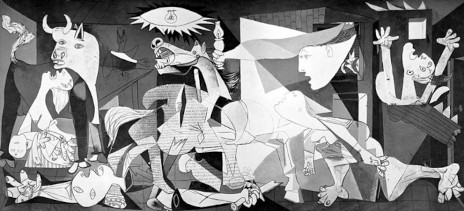
Breaking rules 5: Picasso
“Learn the rules like a pro, so you can break them like an artist.” ― Pablo Picasso
What he said.
Guernica by Pablo Picasso. 1937. Oil on canvas. 349 cm × 776 cm. Breaking rules 4: 八大山人 Bada Shanren
八大山人 简笔写意花鸟画
https://zh.wikipedia.org/zh-sg/%E5%85%AB%E5%A4%A7%E5%B1%B1%E4%BA%BA
https://en.wikipedia.org/wiki/Bada_Shanren
Bada Shanren (1626—1705) was a Chinese painter with one of the most fundamental impact on modern day Chinese ink painting and art. His noble background and recluse lifestyle is quite interesting, but putting that aside, let's consider his art and how he broke rules.
Differing from the classical and precise paintings that's more typical of traditional Chinese ink painting, Bada Shanren's simplified and cartoon-like animals embody a lot of character and symbolism, and brings them from just being 2-D representational depictions to becoming conceptual symbolic art in our world.
To me, I find the almost careless expressions worn on the visages of the characters and the carelessness expressed in the brush strokes particularly noteworthy.
Recently viewed a lecture discussing his art - he said that BadaShanren didn't used to be exceptionally skilled in his drawings - so that's quite encouraging.
Breaking rules 3: Paul Signac & the neo-impressionists
Was trying to recall Georges Seurat's name when I was pointed to Paul Signac.
https://en.m.wikipedia.org/wiki/Paul_Signac
By deconstructing painting (and portraying things with dots or points) he helped set the direction for neo-impressionsists as well as dot-matrix and ink jet printers, perhaps?
I particularly like the following image for its highly stylised background that reminds me of modern graphic design.
| Artist |
|
||||
| Title |
Deutsch: Portrait Félix Fénéon
English: Portrait of Félix Fénéon
|
||||
| Date | |||||
| Medium | oil on canvas, enamel of a rhythmic background of measures and angles, shades and colors | ||||
| Dimensions | 73.5 x 92.5 cm | ||||
| Current location | |||||
Breaking rules 2: Pollock
When I thought about breaking the rules, Jackson Pollock came to mind. Sure, there were the impressionists from the 19th century that were moving away from the traditional style of painting, but nobody was quite as thorough as Pollock at breaking ALL the rules of painting.
"By the mid 1940s, Jackson Pollock introduced his famous 'drip paintings', which represent one of the most original bodies of work of the century, and forever altered the course of American art. At times the new art forms could suggest the life-force in nature itself, at others they could evoke man's entrapment - in the body, in the anxious mind, and in the newly frightening modern world."
Personally, I feel that there is some similarities between his creative process and that of Chinese ink works, for his works are, as he puts it,
"Energy and motion made visible - memories arrested in space." Jackson Pollock
Convergence, 1952, 93.5 inches by 155 inches (237.49 by 393.7 cm), Oil on canvas
http://www.jackson-pollock.org/convergence.jsp#prettyPhoto
http://www.albrightknox.org/collection/collection-highlights/piece:pollock-convergence/
Breaking rules 1: HDB
The HDB apartment blocks has become an icon of Singapore. It's the result and testament to one of the most successful public housing policies in the world. The void deck is its most distinctive feature.
In the past, HDB apartments are made of bricks - red bricks, laid one over another - but now, prefabricated walls come from factories. Many like to compare the new apartments to the old ones. Explaining that the old types give its inhabitants a sturdier feel - especially if one didn't watch cranes hoist concrete slabs to be joined together like lego toy bricks in the estate facing your windows.
Oh but isn't it a marvel of human engineering? It resolves problems like land shortage and rising labour costs with new technology.
Good design solves problems.
And which design rules did it break?
1. I think all over the world, except in Singapore, and some mega cities, highrise buildings were not usually associated with cheap, public housing, as they tend to be more expensive to build.
2. The Void Deck - why did who decide that the first level of all the apartment blocks be left empty. It seems intuitively not right to balance a tall and heavy building on just a bunch of sticks - other than if one refers to the kampong houses that were built on stilts.
Subscribe to:
Posts (Atom)