Showing posts with label Chinese ink. Show all posts

Tuesday, September 22, 2015

扬州八怪

http://baike.baidu.com/subview/2326/4987555.htm

One of the most creative group of artists, loosely connected, but all of the Qing Dynasty. Including Luo Ping who claimed to have seen the ghouls and ghosts he drew. This picture below depicted all of them together, which is also a figment of the artist's imagination and a forced connection that was made. For the 8 artists never conferred together like that.

Friday, September 18, 2015

Ang Chiat's work

Combining Chinese ink and symbolism with icons and reference to computer technology through collage.

Mrt station + art gallery

Don't know who thought of it but mrts are good spaces to display art. Well, other than big advertisement panels.

Wednesday, September 16, 2015

Sumi ink and surrealist animals

http://www.spoon-tamago.com/2015/09/14/animals-camouflaged-by-cloudy-pools-of-sumi-ink-by-miki-saito/

Monday, August 31, 2015

Da Vinci master copy


My friends suggested master copy to improve my drawings.
I'll do that if I had more time. Too much homework.
http://comfortpit.com/drawing-exercises-leonardo-da-vinci/

I wonder how would the below look like in chinese ink.

Leonardo da Vinci grotesque heads

Saturday, August 15, 2015

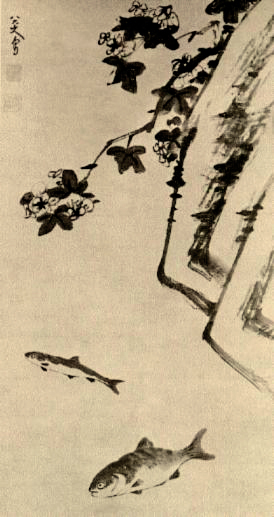
Rock and Two Fish by Ba Da Shan Ren


Another painting by Zhu Da. At first glance, my favourite stroke is the one in the centre, defining the left and underside of the rock, and I shall only look at the stroke for now.
Perhaps, if I shift my eye, my favourite stroke may change in the next instant.
 

https://upload.wikimedia.org/wikipedia/commons/1/11/Zhu_Da.JPG
https://en.wikipedia.org/wiki/Bada_Shanren#/media/File:Zhu_Da.JPG

Tuesday, August 4, 2015

Reflection: Chinese calligraphy and 风调雨顺


A friend asked me about these characters for his artwork.

I explained that these four characters reflects the idea of literally, wind being tuned and rain being easy going. Signifying smooth proceedings.

I suppose it reflects my hopes for my fine art pursuits as well.


http://www.nipic.com/show/3/24/5996297k5183d23f.html


A lot of people don't understand my interest in Chinese calligraphy and ink, even close friends, especially when I come across as somebody who is very western in style and mannerism.
I think, well, as with any other artists and a medium they admire or choose, it's a complicated decision that is compelled by very many reasons.


At the practical level, I like the versatility and efficiency of just black ink and brush and paper. Say, as compared to the more complicated requirements of oil painting. As a water based medium, it is also easier to clean up!

At the basic level, it's because I am a writer and it is sensible that my entry point into visual arts is through writing.

At an intellectual level, I admire the literary and historical aspects of calligraphy, and that the philosophies reflected in the writings and lived out by the ancients. They occupy me.

At a personal development level, it helps me become more observant, patient, and focused.

Being a late starter and not being as strong as I'd like to be in the Chinese language itself, especially in writing it, and most of all, not having enough time and effort to practise more often, I am aware that the chances of me doing very well in calligraphy in this lifetime are low. In that sense, it's not so much about the outcome.

But, in spite of that, the benefits of Chinese calligraphy is still very valuable to me, and we must always remember to do things for reasons beyond the apparently important.

[300 words]

Sunday, August 2, 2015

Breaking rules 4: 八大山人 Bada Shanren


八大山人 简笔写意花鸟画

https://zh.wikipedia.org/zh-sg/%E5%85%AB%E5%A4%A7%E5%B1%B1%E4%BA%BA
https://en.wikipedia.org/wiki/Bada_Shanren

Bada Shanren (1626—1705) was a Chinese painter with one of the most fundamental impact on modern day Chinese ink painting and art. His noble background and recluse lifestyle is quite interesting, but putting that aside, let's consider his art and how he broke rules.

Differing from the classical and precise paintings that's more typical of traditional Chinese ink painting, Bada Shanren's simplified and cartoon-like animals embody a lot of character and symbolism, and brings them from just being 2-D representational depictions to becoming conceptual symbolic art in our world.

To me, I find the almost careless expressions worn on the visages of the characters and the carelessness expressed in the brush strokes particularly noteworthy.

21 11 3.JPG

Recently viewed a lecture discussing his art - he said that BadaShanren didn't used to be exceptionally skilled in his drawings - so that's quite encouraging.

Breaking rules 2: Pollock


When I thought about breaking the rules, Jackson Pollock came to mind. Sure, there were the impressionists from the 19th century that were moving away from the traditional style of painting, but nobody was quite as thorough as Pollock at breaking ALL the rules of painting.


"By the mid 1940s, Jackson Pollock introduced his famous 'drip paintings', which represent one of the most original bodies of work of the century, and forever altered the course of American art. At times the new art forms could suggest the life-force in nature itself, at others they could evoke man's entrapment - in the body, in the anxious mind, and in the newly frightening modern world."

Personally, I feel that there is some similarities between his creative process and that of Chinese ink works, for his works are, as he puts it,
"Energy and motion made visible - memories arrested in space." Jackson Pollock
Convergence, 1952 by Jackson Pollock
 Convergence, 1952, 93.5 inches by 155 inches (237.49 by 393.7 cm),  Oil on canvas

http://www.jackson-pollock.org/convergence.jsp#prettyPhoto
http://www.albrightknox.org/collection/collection-highlights/piece:pollock-convergence/

Wednesday, July 29, 2015

Xu Bei Hong's horse

Chanced upon Xu Bei Hong's work.
Shaw Building.